


Foreign direct investment (FDI) rose by about 6% last year, reaching US$1.6 trillion. More than 80% of it went to just twenty economies. Most free zones are not among them.
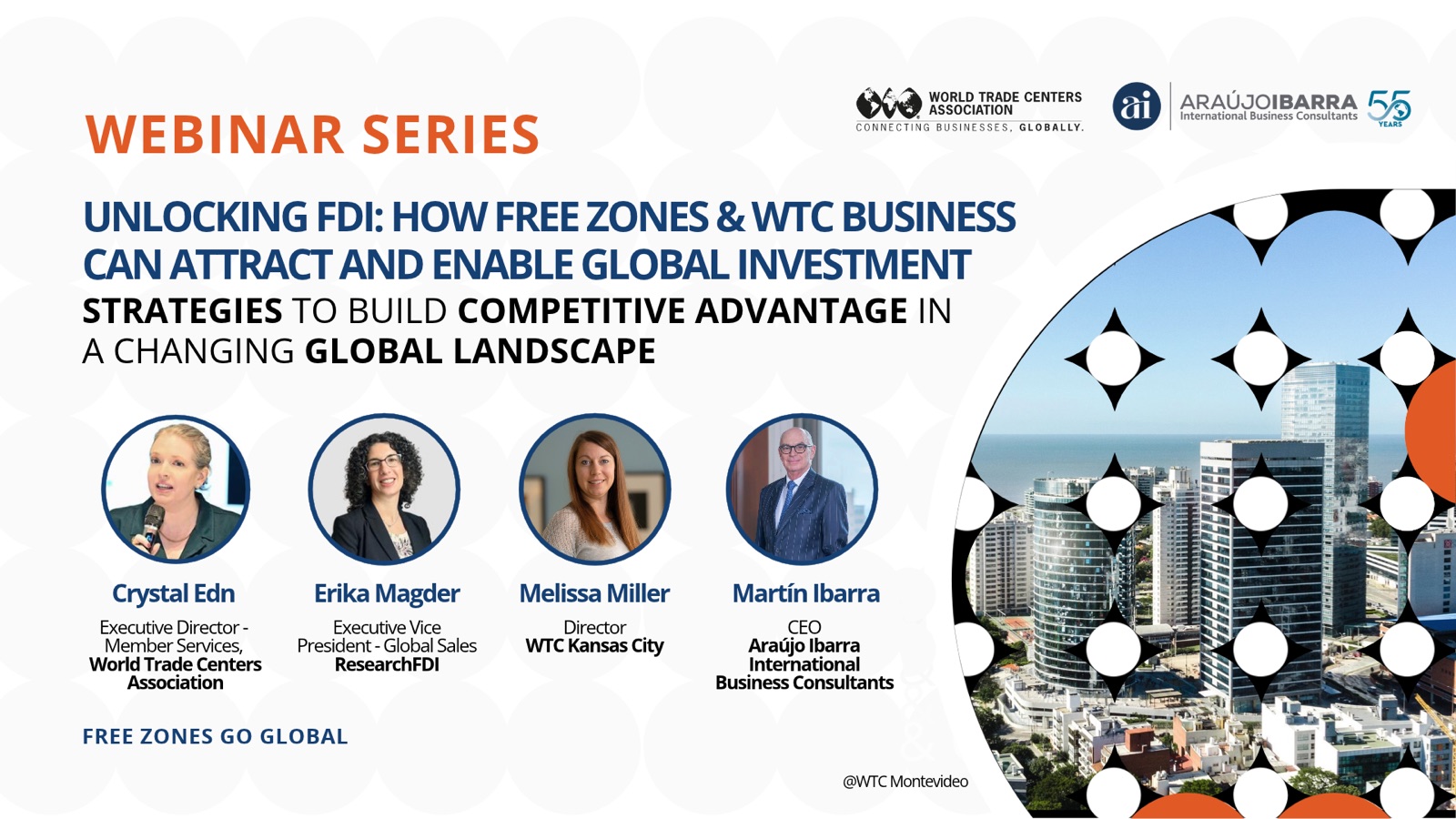
On 19 October, we held the third webinar of the Free Zones Go Global alliance. Our CEO, Martín Gustavo Ibarra, joined an expert panel featuring keynote speaker Erika Magder, Executive Vice President of Global Sales at ResearchFDI and a specialist in investment attraction for free zones and investment promotion agencies. The panel also included Crystal Edn, Executive Director of Member Services at the World Trade Centers Association, and Melissa Miller, Director of WTC Kansas City. The question was practical: how does a free zone win the investment it is not getting?
Free zone investment attraction: the six steps that determine success
Erika Magder began by clarifying what investment attraction actually involves. Most zones treat it as promotion: a website, a campaign, or a stand at a trade show. But these represent only the final 10% of the work. Everything that determines an investment decision happens before that, across six steps.
- Position. Where can your zone realistically compete?
- Prioritize. Which sectors offer the best chance of success?
- Identify. Which companies in those sectors are genuine investment prospects?
- Engage. Who makes location decisions, and how do you reach them?
- Convert. How do you turn initial interest into a site visit and, ultimately, an investment decision?
- Retain and expand. How do you grow the investment you already have?
Four steps deserve a closer look
Deciding where you can compete. Establish what your zone is uniquely positioned to offer: land, the skills available in the surrounding region, not just within the zone itself, connectivity, energy, and suppliers. Benchmark these strengths against those of zones competing for the same sector worldwide, because that is the comparison investors make. The outcome should not be a slogan, but a clear statement of why an investor should choose your zone over its competitors.
Prioritizing, even when it is uncomfortable. When asked what single point she most wanted the audience to take away, Magder chose this one. Most zones want to claim that they serve every sector. Her distinction is important: you never have to turn business away, but you do have to choose where to focus your proactive efforts. A zone that fills its land with whatever investment comes along risks losing the space and ecosystem that would have made it competitive. Moreover, most free zones are fortunate to have only one or two people dedicated to business development. Their efforts must therefore focus on sectors in which the zone has a genuine competitive advantage.
Getting prospects to visit, and then answering the phone. Databases provide names; expansion signals reveal genuine prospects. These signals might include a funding round, an acquisition, or a change in leadership. A list of a thousand companies can be narrowed down to a hundred worth approaching, with outreach directed at the people who influence location decisions, from chief executives to site selection consultants. Whether a company invests depends heavily on whether its representatives ever visit the zone and what they experience when they do. The main obstacle is rarely the incentive regime; more often, it is slow response times. Investors routinely complain that nobody gets back to them.
Growing from within the zone. A tenant that arrives with five employees and a small warehouse may eventually expand or remain a small operation, depending on the relationship built with it afterwards. Existing tenants are also among a zone’s most credible sources of new investment prospects.
Costa Rica’s Coyol Free Zone illustrates what this sequence looks like in practice. Positioned as Latin America’s life sciences hub, it focuses on medical devices and has built an ecosystem around the supplier networks these companies need. Seven of the world’s top 30 medical device companies now operate there. What attracted them was not an incentive, but an ecosystem they could become part of.
Choosing trade shows based on evidence
Most promotional budgets are spent on events, so the keynote concluded with guidance on how to choose them. Start by examining who actually attends: a hall full of sales teams is unlikely to generate an investment decision, while a smaller, more targeted event may deliver better results. Prioritize events designed to facilitate meetings over conferences where networking opportunities are limited. Ask other zones what results they achieved at a particular event, and calculate the full cost, including the booth, travel, and opportunity cost, against the sectors you have prioritized.
What underpins the strategy: free zone regimes and World Trade Centers
There are roughly 8,000 free zones across 145 countries today, up from 500 when the World Trade Organization was established. The zones capturing demand in this crowded landscape are organized around specific industries of the future, rather than simply offering available land.
Two instruments support this approach. A free zone regime can reduce costs by exempting construction materials from duties, potentially lowering building costs by 10% to 15%. It can also provide duty exemptions for equipment installed within the zone, alongside corporate and municipal tax benefits in many countries.
A World Trade Center, meanwhile, provides recognition and reach through a network of 300 centers in more than 100 countries, representing over one million companies. Neither instrument can substitute for the other, and there are three ways to combine them: integrate a free zone regime into an existing World Trade Center’s real estate, turning vacant floors into facilities for service-based free zone activities or using an adjacent plot for a data center; adopt the World Trade Center brand for an existing free zone; or design a new project that combines both from the outset.
In Kansas City, the World Trade Center works alongside two foreign-trade zones that handle approximately US$3 billion in goods annually. The two organizations also have representation on each other’s boards, helping ensure that their relationship is functional rather than merely nominal.
Santiago Free Zone is pursuing a similar approach on a larger scale. It is using the brand to triple the size of a free zone traditionally built around textiles and tobacco while shifting its focus towards services, electronics, and data centers.
What it all adds up to
Almost nothing a free zone offers is scarce anymore. What is scarce is clarity: a sector in which it can credibly compete, an ecosystem investors can picture themselves operating in, and a team that answers the phone.
The first requires a decision. The second takes years to build. The third can start tomorrow.
Ready to decide where your free zone can actually win?
Watch the webinar recording: Unlocking FDI for Free Zones – Free Zones Go Global webinar (YouTube)