

There are close to 10,000 data centers in the world today, and that number is expected to double within five years. The capital behind that expansion is already looking beyond the markets that absorbed the first wave. So the question for free zone leaders is not “what do we have to offer?”, but whether the developers deciding where that capital lands can see what a zone already has.
The webinar the World Trade Centers Association and Araújo Ibarra International Business Consultants hosted earlier this month offered a useful starting point for answering that question. Moderated by Scott Wang, Vice President for Asia Pacific at WTCA, it brought together Martin Antunez, CEO of LATAM Entry, with more than thirty years developing digital infrastructure across the United States, Europe and Latin America; Martín Ibarra, CEO of Araújo Ibarra International Business Consultants and a leading expert on free zones and international trade; and Ignacio Del, CEO of WTC Punta del Este and WTC Montevideo Free Zone. The premise is that three ecosystems that have operated separately are now converging: the World Trade Center, the free zone and the data center.
Three insights stood out:
- A data center is a real estate business, and it is the densest one available. Martín Ibarra’s reframe changes who the conversation belongs to. Behind the 300+ World Trade Centers in more than 90 countries are real estate developers. A zone that already builds for logistics, industry and offices is being asked to build for servers instead, with far more value concentrated per square foot than any of its current tenants generate. For centers still holding space the pandemic emptied, that is a new use for an asset they already own.
- The site selection criteria never change, and free zones already solve most of them. Wherever the destination, and whether the developer is a hyperscaler or an operator building to lease, Martin Antunez described the same checklist: cost of energy, fiber connectivity, land, construction capacity, regulatory certainty and macroeconomic stability. Land inside a free zone arrives industrialized and with power in place, so capital goes into building rather than into clearing obstacles. The fiscal architecture reinforces it: VAT relief on construction materials, imports of servers, cooling and backup equipment free of duties and VAT, and corporate rates that fall to 20% in Colombia, 12.5% in Jamaica and to zero in Costa Rica, the Dominican Republic and El Salvador.
- The decisive factor has moved from tax to power, and from power to social license. More than thirty US states have passed measures to monitor or restrict data center development, and US policy now pushes large deployments to bring their own generation rather than draw from the grid. The industry’s own read was candid: it has done a poor job of explaining itself to the communities it enters. Free zones offer what cannot be bought on the open market: an operator already integrated into the local education system, transport and environment. As Antunez put it, telling a client you are buying land next to a free zone and telling them you are buying inside one are two very different conversations. That is the power of the brand.
The regional opportunity follows from there. Latin America holds roughly double the population of the United States and accounts for less than 0.5% of the world’s data center power consumption, against the roughly 10% consumed by the US. Colombia shows what closing that gap looks like: around 95% of its data centers sit inside free zones, and every free zone in Bogotá hosts a data center operator or a hyperscaler.
A model already in operation: WTC Montevideo
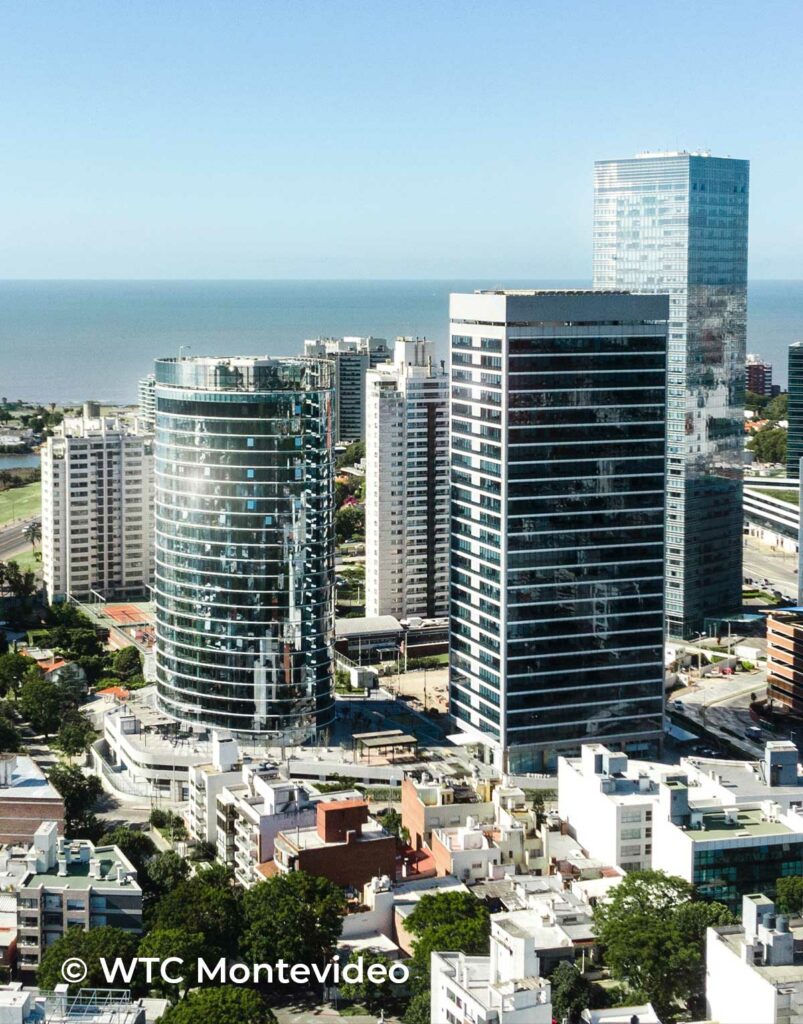
The convergence is not a projection. WTC Montevideo Free Zone and WTC Punta del Este already bring the three components together in a single development: the World Trade Center brand and the network behind it, Uruguay’s free zone regime, and a data center in every building. The regime offers full exemption from corporate income tax, wealth tax and VAT, guaranteed by the Uruguayan state and unchanged across more than 35 years and governments of both left and right. The infrastructure runs on a renewable matrix close to 100% with energy redundancy and a 99% service level agreement, on a platform that has helped more than 500 companies establish operations.
Ignacio Del framed the ambition beyond Uruguay: grow the model rather than keep it, because a larger regional market benefits every zone in it. From that example, three paths follow for World Trade Centers weighing where they fit. Host data center capacity in space they already hold. Build a free zone designed from the outset for digital infrastructure. Or bring the WTC brand to free zones that already have the land and the power, but not yet the visibility to reach the investors who would use them.
Free zones spent decades competing on fiscal terms. In digital infrastructure the incentives are necessary but no longer decisive. What decides where a hyperscaler lands is whether a zone can offer power, connectivity, legal certainty and a community that already trusts it, all in the same place, and whether the developers deciding where that capital goes can see that it does.
Ready To Position Your Free Zone For Data Center Investment?
Schedule a session with our team